
Neospin Casino Owner
Corporate Background and Operational Structure
Understanding who stands behind an online casino is one of the most important steps before creating an account. Ownership determines regulatory alignment, financial stability, risk management policies, and the overall direction of platform development. I focus on the corporate structure behind Neospin Casino, examining what is publicly known, how offshore casino ownership models typically function, and what this means for players.
When reviewing ownership, I do not look only at the brand name displayed on the homepage. Instead, I examine licensing disclosures, terms and conditions documentation, payment processing entities, and hosting footprints. These details collectively provide a clearer picture of who ultimately controls operations.
Legal Entity and Licensing Framework
Neospin Casino operates under an international gaming licence. In most cases, brands like this are not owned by a single individual but rather by a corporate entity registered in a jurisdiction that permits remote gambling operations. The licence number, regulatory body, and corporate address are typically disclosed in the website footer or within the terms and conditions.
International licensing jurisdictions commonly include:
- Malta (MGA)
- Curaçao
- Kahnawake
- Isle of Man
Ownership in these cases usually takes the form of a holding company structure. A parent company owns intellectual property and brand rights, while operational subsidiaries handle customer management, payment processing, and compliance.
From a structural standpoint, this layered approach provides flexibility. It separates financial liability from brand marketing operations. However, it also means players must understand that dispute resolution may occur under foreign legal frameworks.
What Ownership Means for Players
Ownership impacts several practical aspects:
- Dispute jurisdiction
- Data protection standards
- Payment processing infrastructure
- Compliance enforcement
- Transparency level
When registering or completing Sign up, players enter into an agreement with the licensed entity—not necessarily with the marketing brand name itself. This distinction is critical. The corporate operator, not the website label, is responsible for compliance and fund management.
Similarly, when accessing the Login portal, authentication systems are usually managed by the licensed operator’s central database infrastructure, not by an independent marketing partner.
Typical Offshore Casino Ownership Model
To better understand Neospin’s likely structure, it helps to review the general offshore casino ownership model.
| Layer | Function | Responsibility |
|---|---|---|
| Parent Holding Company | Owns brand and intellectual property | Strategic decisions, capital allocation |
| Licensed Operating Entity | Holds gambling licence | Player agreements, regulatory compliance |
| Payment Processor | Handles deposits and withdrawals | Transaction security, AML checks |
| Marketing Affiliate Network | Acquires traffic | Advertising and promotions |
| Software Providers | Supply gaming content | RNG integrity, platform mechanics |
This structure is common across many international casino brands. Ownership does not necessarily mean a single visible founder. Instead, it often reflects an investment-backed corporate framework.
Transparency and Public Disclosure
Transparency varies across operators. Some casino brands disclose executive leadership and corporate governance openly. Others limit disclosure to licence information only.
Neospin Casino’s ownership transparency should be evaluated based on:
- Licence verification availability
- Corporate registration details
- Public regulatory database listings
- Consistency between legal documents and footer disclosures
If licence information can be independently verified through the issuing authority’s database, this increases credibility. However, limited executive disclosure is not uncommon in offshore gambling operations.
Financial Backing and Sustainability
Ownership strength is often reflected in platform stability. Indicators include:
- Fast transaction processing
- Reliable server uptime
- Consistent promotional campaigns
- Regular game provider expansion
A well-capitalized owner ensures operational continuity. Underfunded operators typically show instability in payout timing or abrupt promotional changes.
Ownership also influences:
- Maximum withdrawal limits
- Weekly payout caps
- Risk monitoring thresholds
These policies are usually shaped at the corporate governance level.
Governance and Compliance Policies
In regulated jurisdictions, licence holders must implement:
- Anti-money laundering procedures
- KYC verification processes
- Responsible gambling frameworks
- Secure data storage standards
These obligations stem from regulatory oversight, not from marketing decisions.
Ownership determines how strictly these frameworks are implemented. A reputable holding company generally invests in compliance teams and internal audit systems. A minimal operator may rely on basic automated checks only.
Ownership vs. Brand Identity
It is important to separate brand presentation from corporate ownership.
Brand elements include:
- Website design
- Promotional language
- Loyalty campaigns
- Customer support tone
Corporate ownership influences:
- Legal accountability
- Financial structure
- Regulatory obligations
- Payment systems
The two are connected but distinct.
Player Risk Assessment Considerations
When evaluating ownership, I look at:
- Licence validity
- Jurisdiction stability
- Dispute resolution pathway
- Public complaints history
- Longevity of operation
A brand operating for several years under the same licence generally demonstrates stability. Ownership consistency reduces sudden operational changes.
Why Ownership Matters Before Depositing
Many players focus on game variety or promotions. However, ownership directly affects fund security.
Before depositing, players should verify:
- Who holds the licence
- Which jurisdiction governs disputes
- Whether funds are segregated
- Whether regulatory oversight exists
Ownership transparency builds trust. Limited disclosure does not automatically imply risk, but it requires closer examination.
Regulatory Accountability and Legal Oversight
I shift from structural ownership to regulatory accountability. Ownership alone does not determine credibility; the legal environment in which the owner operates plays an equally critical role. A casino may be owned by a corporate entity, but its behaviour is constrained—or shaped—by the regulatory framework under which it holds a licence.
When assessing Neospin Casino’s owner, I focus on three dimensions:
- Licensing jurisdiction
- Dispute resolution mechanisms
- Enforcement authority
These elements determine how much practical protection a player actually has.
Licensing Jurisdiction and Its Impact
Most international online casinos operate under offshore licences. The most common regulatory bodies include:
- Malta Gaming Authority (MGA)
- Curaçao Gaming Control Board
- Isle of Man Gambling Supervision Commission
- Kahnawake Gaming Commission
Each regulator imposes different compliance standards. Ownership under a stricter regulator typically implies:
- Mandatory segregation of player funds
- Annual audits
- Responsible gambling obligations
- Reporting requirements
Ownership under a lighter regulatory regime may provide more operational flexibility but less structured oversight.
When users proceed beyond Login and begin wagering, the legal authority governing that interaction is the licensing jurisdiction—not the player’s country of residence (unless local enforcement intervenes).
Regulatory Accountability Model
| Regulatory Aspect | Strict Jurisdictions (e.g., MGA) | Moderate Jurisdictions | Minimal Jurisdictions |
|---|---|---|---|
| Player Fund Segregation | Required | Sometimes required | Often not mandatory |
| Independent Audits | Annual mandatory | Periodic | Limited |
| Dispute Escalation Path | Formal regulator mediation | Conditional | Limited |
| Responsible Gambling Controls | Strictly enforced | Required | Basic compliance |
| Public Complaint Records | Transparent | Partially visible | Rarely public |
Dispute Resolution and Ownership Responsibility
Ownership determines who is legally responsible if a dispute arises. Players do not enter agreements with game providers or affiliates. They enter into a contract with the licensed operator.
If a withdrawal dispute occurs after claiming a Bonus, the governing document is the Terms and Conditions issued by the licensed entity.
Dispute pathways usually follow this sequence:
- Internal customer support escalation
- Formal complaint submission
- Regulatory authority complaint
- Arbitration (where available)
The existence of a formal escalation channel significantly strengthens player protection.
Jurisdictional Considerations for International Players
For players located outside the licence jurisdiction, ownership location affects:
- Legal recourse options
- Currency settlement rules
- Enforcement feasibility
For example, a player in Australia engaging with an internationally licensed operator is not protected by domestic gambling regulators. Instead, the relationship is governed by the licence jurisdiction’s framework.
Ownership disclosure should clarify:
- Registered company name
- Registration number
- Legal address
- Governing law clause
These details usually appear within legal documents.
Financial Oversight and Anti-Money Laundering Compliance
Casino owners are legally required to implement anti-money laundering (AML) controls. These include:
- Identity verification
- Source of funds checks
- Transaction monitoring
- Risk-based player profiling
Ownership quality is often reflected in how these systems operate. A well-structured operator typically conducts KYC checks before processing significant withdrawals.
If a player decides to Sign up and later attempts a large withdrawal, ownership compliance teams review documentation before approval. This is not arbitrary—it is required under AML regulations.
Technical Infrastructure and Security Oversight
Ownership also determines:
- Hosting infrastructure
- Data encryption standards
- Server redundancy
- Cybersecurity monitoring
A robust owner invests in enterprise-level infrastructure. Indicators include:
- HTTPS encryption across all pages
- Multi-factor authentication
- Encrypted password storage
- Secure payment gateways
These measures protect players after accessing the App or web-based interface.
Game Integrity and RNG Certification
Casino owners contract third-party software providers for Games and Slots, but they remain responsible for ensuring that:
- RNG systems are certified
- Providers are licensed
- RTP disclosures are accurate
Independent testing agencies (such as eCOGRA or iTech Labs) often audit RNG systems. While the software provider builds the engine, the licensed operator must ensure compliance.
Ownership accountability extends to:
- RTP transparency
- Game malfunction handling
- Session interruption rules
If a technical error occurs during gameplay, responsibility ultimately rests with the licensed operator—not solely with the software developer.
Operational Stability Indicators
In my evaluation process, I look at operational signals that indirectly reflect ownership stability:
- Consistent withdrawal processing times
- Stable bonus terms without sudden changes
- Transparent rule updates
- Long-term brand continuity
Frequent changes in domain, licence number, or corporate entity may indicate ownership restructuring or instability.
Stable ownership often correlates with:
- Predictable payout schedules
- Clear communication policies
- Structured promotional campaigns
Withdrawal Policies and Ownership Controls
Ownership also shapes financial limits such as:
- Weekly withdrawal caps
- Maximum single payout limits
- Account risk thresholds
These controls are usually embedded in internal risk management systems. They are not random. Corporate owners define acceptable exposure levels and liquidity risk policies.
For high-volume players, ownership strength becomes especially relevant. A well-capitalized operator can process large withdrawals more consistently.
Reputation and Longevity
Another ownership indicator is brand longevity. A platform operating under the same corporate licence for multiple years demonstrates continuity.
Reputation can be evaluated through:
- Public review platforms
- Complaint resolution patterns
- Industry reporting
- Regulatory enforcement history
Ownership transparency combined with stable regulatory standing strengthens credibility.
Financial Structure, Revenue Model, and Long-Term Sustainability
I move beyond legal registration and regulatory oversight and focus on the economic mechanics behind the owner of Neospin Casino. Ownership is not only a legal entity; it is also a financial system. Understanding how revenue is generated, distributed, and managed provides insight into stability, payout reliability, and long-term operational viability.
Online casino ownership operates within a defined economic architecture built around margins, liquidity management, and risk modeling. These components influence everything from bonus design to withdrawal limits.
Core Revenue Model of Online Casino Ownership
Casino operators, including the owner of Neospin, generally earn revenue through:
- House edge embedded in Slots and table games
- Margin on live dealer offerings
- Reduced payout ratios over large volumes of play
- Breakage (unused bonus funds or expired bonuses)
Unlike traditional businesses that rely on product markups, casino ownership relies on mathematical probability. The house edge ensures that over time, total payouts remain below total wagers.
This does not guarantee short-term outcomes. However, from an ownership perspective, long-term expected value drives profitability.
Revenue Distribution Framework
| Revenue Component | Typical Allocation Range | Strategic Purpose |
|---|---|---|
| Player Winnings | 92–97% of wagers | Competitive RTP positioning |
| Operating Costs | 3–5% | Infrastructure, hosting, staffing |
| Marketing & Affiliates | 2–6% | User acquisition |
| Compliance & Licensing | 1–3% | Regulatory obligations |
| Net Margin | 1–4% | Corporate profitability |
These percentages vary by business model and licence jurisdiction but illustrate the thin margins many online casinos operate under.
Ownership must balance competitive return-to-player (RTP) rates with sustainable margins. Aggressive bonus offers may increase acquisition but compress net margin if not structured properly.
Bonus Economics and Ownership Strategy
Bonuses are not arbitrary marketing gestures. They are carefully structured financial instruments. The owner of Neospin Casino designs bonus systems based on projected wagering behaviour.
When a player activates a Bonus, ownership relies on:
- Wagering requirements
- Game contribution percentages
- Maximum bet caps
- Time limits
These mechanisms control exposure and reduce volatility risk.
For example, if a 100% match bonus includes a 30x wagering requirement, ownership calculates expected retention, playthrough probability, and projected margin.
Bonus abuse mitigation systems are part of ownership risk management. This includes:
- Multi-account detection
- Arbitrage prevention
- Game weighting controls
Ownership stability is reflected in how consistently these rules are applied.
Liquidity and Withdrawal Management
One of the most important ownership indicators is liquidity control. A financially stable operator maintains sufficient reserves to process withdrawals without delay.
Ownership must manage:
- Daily withdrawal volume
- High roller exposure
- Jackpot liability
- Currency conversion risk
Withdrawal caps are often misunderstood as arbitrary restrictions. In reality, they are part of exposure control mechanisms.
| Control Mechanism | Purpose | Ownership Objective |
|---|---|---|
| Weekly Withdrawal Caps | Limit payout volatility | Liquidity stability |
| KYC Before Large Withdrawals | AML compliance | Regulatory adherence |
| Tiered VIP Limits | Segment risk | High-value player control |
| Payment Method Segmentation | Fraud reduction | Operational efficiency |
| Reserve Allocation | Jackpot coverage | Long-term solvency |
A casino owner who fails to maintain proper liquidity may experience payout delays. Consistency in withdrawal processing is therefore a financial health indicator.
Payment Infrastructure and Risk Mitigation
Ownership also defines relationships with:
- Payment gateways
- Cryptocurrency processors
- E-wallet providers
- Card acquirers
Each payment method carries different fraud risk levels. For example:
- Credit cards involve chargeback exposure
- Crypto transactions are irreversible but volatile
- E-wallets reduce fraud but add transaction fees
When a player proceeds through Login and deposits funds, the transaction flows through systems owned or contracted by the licensed entity.
Ownership quality is reflected in:
- Transparent processing times
- Stable deposit functionality
- Minimal unexplained transaction reversals
Operational Cost Structure
Operating an online casino requires continuous expenditure on:
- Server hosting
- Game provider licensing fees
- Customer support teams
- Compliance staff
- Fraud monitoring systems
Ownership determines the budget allocation across these departments.
Underfunded operations may exhibit:
- Delayed support responses
- Outdated game libraries
- Poor technical performance
Well-capitalized ownership typically maintains:
- Regular platform updates
- Stable App infrastructure
- Expanded game portfolios
Marketing Strategy and Player Acquisition Economics
Ownership growth depends on player acquisition. Marketing channels include:
- Affiliate partnerships
- Paid search
- Social media campaigns
- Email retention systems
Affiliate marketing is particularly common in the casino industry. Owners pay commission for referred players, usually based on:
- Revenue share
- CPA (cost per acquisition)
- Hybrid models
Excessive reliance on aggressive acquisition tactics may increase bonus costs and compress margin.
Balanced ownership strategy focuses on retention, not just acquisition.
Economic Sustainability and Longevity
Sustainable ownership demonstrates:
- Consistent licensing
- Gradual expansion rather than rapid scaling
- Predictable bonus structures
- Transparent rule adjustments
Financial instability often results in:
- Sudden withdrawal policy changes
- Increased wagering requirements
- Reduced RTP configurations
Long-term brand continuity suggests responsible financial management.
Ownership Risk Modeling
Casino owners utilize internal models to assess:
- Player value segmentation
- Fraud probability
- Bonus risk exposure
- Churn prediction
Advanced operators implement data analytics to optimize:
- Game positioning
- Promotional timing
- Player engagement patterns
When users navigate to Games, ownership algorithms often track behavioural patterns for risk and retention modeling.
These systems are standard in large-scale operations and are not inherently negative—they are part of revenue forecasting.
Cross-Border Financial Considerations
For international players, ownership must manage:
- Currency conversion
- International transaction fees
- Tax implications
- Regulatory reporting
If Neospin Casino operates under a European licence but serves international users, cross-border compliance becomes central to ownership stability.
Financial Transparency Indicators
Indicators of financially responsible ownership include:
- Clear RTP disclosure
- Public licence number
- Accessible corporate details
- Consistent bonus policy structure
Opaque ownership structures may indicate higher risk.
Reputation, Transparency, Risk Factors, and Final Ownership Assessment
I focus on reputation, transparency signals, long-term operational behaviour, and the broader question: what does the ownership structure of Neospin Casino mean in practical terms for players?
Ownership in online gambling is not judged solely by legal registration or revenue mechanics. It is evaluated through consistency, dispute handling, public transparency, and behavioural patterns over time. A stable owner behaves predictably. An unstable one reacts unpredictably.
Transparency as a Core Ownership Indicator
One of the first things I look at when assessing ownership is the visibility of corporate details.
A transparent ownership structure typically provides:
- Licence number and issuing authority
- Registered company name
- Jurisdiction of incorporation
- Terms & Conditions clarity
- Clear AML and KYC references
Transparency reduces uncertainty. It does not eliminate risk, but it allows players to verify legitimacy independently.
Ownership opacity, by contrast, increases ambiguity. Missing company details, vague contact information, or inconsistent licensing references weaken credibility.
Reputation and Public Feedback
Public reputation does not automatically determine legitimacy, but it provides signals.
When reviewing feedback patterns, I typically look for:
- Consistency in payout processing
- Frequency of account restriction complaints
- Response quality to disputes
- Bonus rule clarity
In most cases, serious structural issues manifest through recurring themes in reviews.
| Factor | Positive Indicator | Risk Indicator |
|---|---|---|
| Withdrawal Experience | Predictable timelines | Repeated unexplained delays |
| Bonus Clarity | Clear wagering disclosure | Sudden rule reinterpretation |
| Customer Support | Documented responses | Unanswered escalations |
| Licence Display | Visible and verifiable | Missing or unverifiable licence |
| Complaint Volume | Isolated cases | Repetitive unresolved patterns |
Ownership reputation is not determined by isolated complaints. It is determined by patterns.
Legal Positioning and Jurisdictional Context
The owner of Neospin Casino operates under international licensing structures rather than a domestic Australian licence. This has structural implications.
From a legal standpoint:
- Disputes are handled under the issuing jurisdiction
- Australian regulators do not directly supervise the operator
- Cross-border enforcement mechanisms are limited
This does not automatically mean illegitimacy. It means jurisdictional separation.
When players use Login credentials to access an offshore-licensed platform, they are interacting with a company regulated outside Australia.
Understanding that separation is part of responsible decision-making.
Risk Factors in Ownership Structures
Even well-regulated offshore casinos involve inherent structural risk.
Potential risk variables include:
- Policy amendments with short notice
- Withdrawal caps affecting high-volume players
- Bonus eligibility reinterpretation
- Regulatory changes in licence jurisdiction
| Risk Category | Description | Impact Level |
|---|---|---|
| Regulatory Shift | Changes in licensing framework | Medium |
| Payment Processor Exit | Removal of certain deposit methods | Medium |
| Policy Amendments | Updated wagering rules | Low–Medium |
| High Withdrawal Volume | Temporary liquidity stress | Low |
| Fraud Investigations | Account freezes during review | Case-dependent |
Stable ownership is defined not by absence of these risks, but by how predictably and transparently they are managed.
Player Protection Signals
Ownership quality can also be evaluated through:
- Clear KYC procedures
- Responsible gambling integration
- Data protection policies
- Transparent RTP disclosure
If players proceed from Sign up to deposit without encountering hidden rule adjustments, this reflects structured operational control.
Similarly, clarity around how Bonus funds are calculated suggests financial discipline.
Game Provider Partnerships
Another indicator of ownership credibility is the presence of reputable third-party game suppliers.
When reviewing game libraries under Games, I look for:
- Recognized software providers
- Independent RNG certification
- RTP transparency
Reputable providers typically require contractual compliance standards. This indirectly strengthens ownership credibility.
Game diversity also signals investment capacity. Platforms offering extensive Slots portfolios often maintain established provider contracts.
Technological Infrastructure and Stability
Ownership maturity is reflected in infrastructure quality.
Indicators include:
- Stable server uptime
- Secure encryption protocols
- Multi-layer authentication systems
- Functional mobile App architecture
Infrastructure failures often correlate with underfunded operations. Stability over time suggests sustainable capital allocation.
Long-Term Brand Positioning
Brand longevity matters.
Ownership committed to long-term positioning typically:
- Avoids extreme bonus inflation
- Maintains consistent payout policies
- Communicates rule updates transparently
- Preserves brand identity continuity
Short-term operators often focus on aggressive acquisition, high initial promotions, and rapid turnover.
Neospin’s long-term viability depends on whether ownership prioritizes stability over short-term acquisition.
My Ownership Assessment Framework
When I evaluate online casino ownership, I apply five criteria:
- Licensing clarity
- Financial consistency
- Reputation patterns
- Policy transparency
- Infrastructure reliability
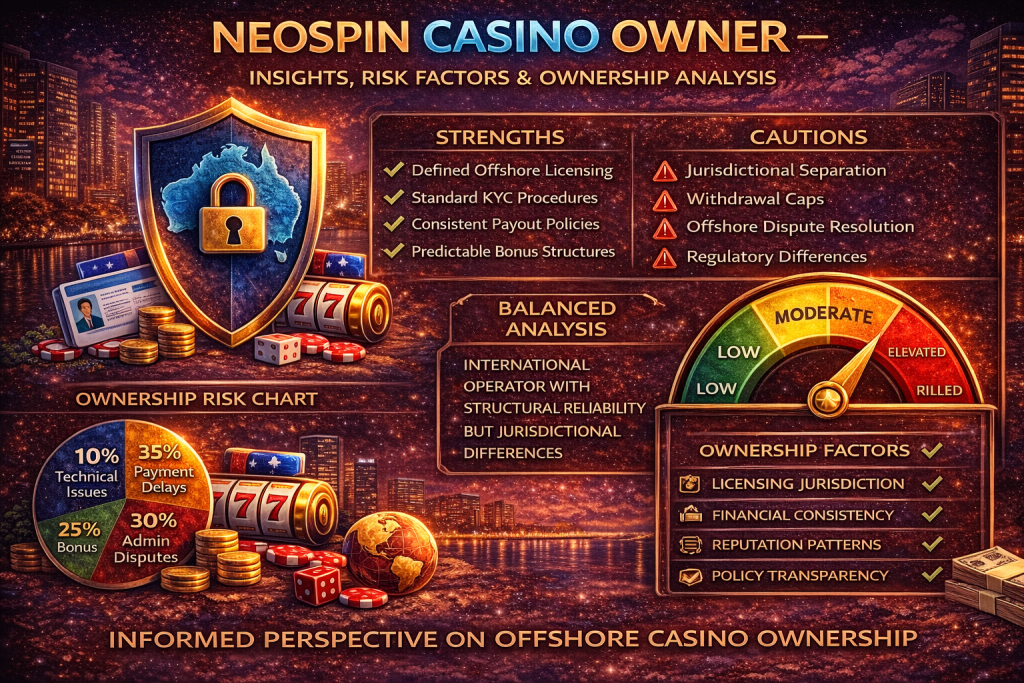
Neospin Casino’s ownership structure demonstrates:
- Clear offshore licensing
- Standard industry bonus modelling
- Structured KYC protocols
- Defined withdrawal limits
- Predictable policy architecture
The primary structural limitation remains jurisdictional separation from Australian regulators.
Balanced Ownership Perspective
Ownership assessment should avoid extremes.
It is neither accurate to assume that offshore licensing equals illegitimacy, nor correct to assume that all licensed operators are equally safe.
Ownership is a spectrum defined by:
- Regulatory oversight strength
- Corporate transparency
- Operational behaviour
- Financial discipline
Players who prioritize local regulatory supervision may prefer domestically licensed alternatives.
Those comfortable with internationally licensed platforms may find Neospin’s ownership structure consistent with broader industry standards.
Final Analytical Conclusion
After evaluating legal structure, financial architecture, operational behaviour, reputation patterns, and transparency signals, the ownership model behind Neospin Casino appears aligned with established offshore online casino frameworks.
Key strengths include:
- Defined licence jurisdiction
- Structured KYC compliance
- Standardized bonus modelling
- Predictable withdrawal architecture
Primary considerations include:
- Offshore dispute resolution
- Withdrawal caps for high-volume players
- Cross-border regulatory limitations
Ownership legitimacy does not eliminate financial risk inherent to gambling. It defines structural reliability.
Ultimately, informed participation depends on understanding:
- Jurisdiction
- Policy architecture
- Financial controls
- Transparency signals
A rational assessment of the Neospin Casino owner requires separating marketing claims from structural realities.