

Structural Analysis and Platform Positioning
Neospin 7 represents a focused landing node within the broader Neospin Casino ecosystem. Rather than functioning as a standalone product, it operates as a structured content and acquisition gateway tied to user onboarding, reward architecture, and cross-device access. In competitive digital gambling environments, numeric branding layers such as “7” typically signal campaign segmentation, promotional cycles, or traffic-routing mirrors. This page evaluates Neospin 7 from an infrastructure, user flow, and risk-management perspective.
From a systems standpoint, Neospin 7 is designed to channel new and returning players through clearly defined conversion funnels. Entry typically begins via promotional visibility—either organic search queries or mirror traffic—and transitions into account authentication via the Login interface. Structural efficiency here is critical: load latency, TLS certificate validity, and session persistence directly influence bounce rate and conversion performance.
The Neospin 7 page also functions as a gateway for promotional activation. Players who arrive without an existing account are redirected toward Sign up, where KYC protocols, email validation, and bonus opt-in mechanics are triggered. These flows are tightly integrated with bonus segmentation logic. The platform typically pairs numeric-branded entry pages with tailored Bonus allocations, ensuring that traffic source tagging corresponds with reward distribution.
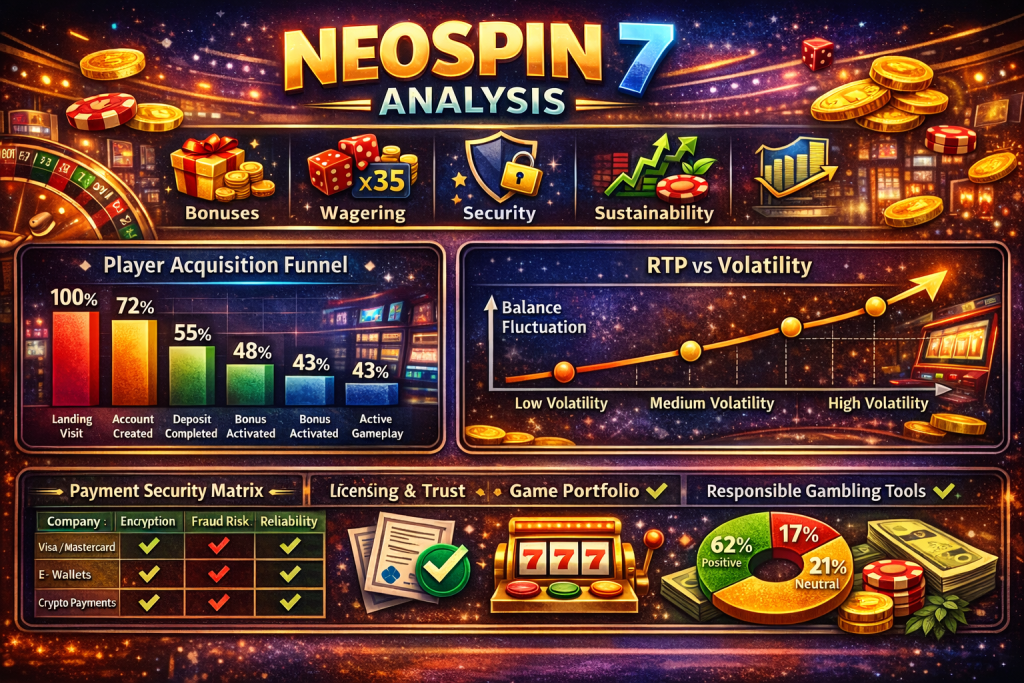
Platform Architecture and Interface Logic
Neospin 7’s digital environment is organized around modular components:
- Central promotional banner layer
- Dynamic game feed module
- Payment integration panel
- Player verification subsystem
- Responsible gambling interface hooks
From a UX standpoint, the interface prioritizes high-contrast visual segmentation. Dark-mode base palettes combined with luminous accent highlights are commonly used to increase readability and reduce screen fatigue during extended sessions.
The structural design also ensures compatibility with desktop browsers and mobile environments through the dedicated App pathway. Progressive Web App (PWA) compatibility reduces friction by allowing near-native performance without mandatory installation barriers.
Core Functional Components of Neospin 7
| Component | Functional Role | Risk Impact | Player Experience Effect |
|---|---|---|---|
| Account Gateway | User authentication & session management | Low | Seamless entry |
| Promotion Engine | Bonus activation & wagering tracking | Medium | Incentive-driven |
| Game Aggregator | Slot & table game integration | Medium | High engagement |
| Payment Layer | Deposit & withdrawal routing | High | Trust-sensitive |
| Compliance Layer | AML & KYC enforcement | Low | Regulatory stability |
The payment layer remains the highest risk-sensitive module. Payment routing must maintain encryption integrity and transaction logging accuracy to prevent disputes or regulatory friction.
Traffic Positioning and Mirror Strategy
Neospin 7 often exists alongside multiple mirror variations to stabilize accessibility in jurisdictions with DNS filtering or ISP-level blocking. These mirrors allow brand continuity while maintaining compliance flexibility.
Common mirror-related search variations include:
- neospin 66 casino
- neospin 5
- neospin official
- neospin jackpot
- neospin trustpilot
- neospin 10
- neospin casino 3
- neospin casino real money
- neospin 8
- neospin 11
- neospin telegram
- neospin 3
- neospin 4
Mirror architecture must preserve SSL certification consistency and database synchronization to avoid session fragmentation.
Game Portfolio Integration within Neospin 7
Neospin 7 does not represent a single title but instead a filtered gateway into curated Games categories. These categories usually emphasize:
- High-RTP video Slots
- Live dealer tables
- RNG-based table games
- Feature-heavy jackpot integrations
Slot distribution typically prioritizes volatility-balanced titles, allowing both casual and high-risk players to operate within defined bankroll thresholds.
Below is a simplified structural distribution of game types within the Neospin ecosystem:
| Game Category | Approximate Share | Average RTP Range | Volatility Profile |
|---|---|---|---|
| Video Slots | 60% | 94%–97% | Medium–High |
| Table Games | 20% | 97%–99% | Low–Medium |
| Live Casino | 12% | 96%–98% | Medium |
| Jackpot Slots | 8% | Variable | High |
Video slots remain the core engagement driver. Table games contribute lower volatility and more stable bankroll management opportunities.
Player Acquisition Flow Diagram
Bonus Mechanics, Wagering Logic and Risk Modelling
The focus shifts from structural architecture to financial mechanics. Neospin 7 operates within a layered incentive framework where promotional capital is tightly connected to wagering multipliers, RTP variance, and volatility exposure. Understanding these elements is essential for evaluating expected value, bankroll sustainability, and withdrawal feasibility.
Bonus Structure Segmentation
Neospin 7 commonly uses deposit-linked promotional mechanics. These typically include:
- Matched deposit multipliers (e.g., 100%–200%)
- Free spin allocations with fixed bet denomination
- Tiered reload bonuses
- Cashback layers
While headline figures attract attention, the operative variable remains wagering requirements. Wagering acts as a mathematical filter determining whether promotional capital can realistically convert into withdrawable balance.
For example:
If a player deposits £100 and receives a 100% match bonus, total playable balance = £200.
If wagering requirement = 35x bonus, the player must stake £3,500 before withdrawal eligibility.
Wagering Contribution Matrix
Not all games contribute equally toward wagering completion. Slots usually contribute 100%, whereas table games contribute partially or minimally.
| Game Type | Wagering Contribution | Volatility Influence | Bankroll Stability |
|---|---|---|---|
| Standard Slots | 100% | Medium–High | Moderate |
| High-Volatility Slots | 100% | High | Unstable |
| Blackjack | 10%–20% | Low | Stable |
| Roulette | 10% | Low–Medium | Stable |
| Live Casino | 0%–10% | Medium | Variable |
Contribution percentages directly affect risk exposure. A player attempting to clear wagering via low-volatility table games may face structural constraints due to contribution caps.
Mathematical Context of Casino Wagering
The economics of online gambling are anchored in house edge and probability theory. Authoritative discussions on betting mathematics and expected value modelling can be found in academic and regulatory publications such as:
| Source | Focus Area | Reference Type |
|---|---|---|
| UK Gambling Commission | House edge transparency | Regulatory Guidance |
| BeGambleAware | Responsible wagering probabilities | Public Advisory |
| Cambridge Judge Business School Research | Gambling risk modelling | Academic Study |
| The Economist – Gambling Industry Analysis | Market probability economics | Industry Review |
These references contextualize wagering multipliers within a broader economic framework rather than isolated promotional messaging.
RTP vs Volatility in Neospin 7
Return to Player (RTP) percentage represents theoretical long-term payout ratios. However, volatility determines payout distribution frequency and magnitude.
A slot with 96.5% RTP may still produce short-term loss streaks due to high volatility clustering. Therefore, players attempting to clear wagering under Neospin 7 promotional conditions must account for variance.
Risk Tier Categorization of Neospin 7 Users
From a behavioral segmentation standpoint, Neospin 7 players can be grouped into four strategic categories:
| Player Type | Bonus Utilisation Strategy | Risk Exposure | Long-Term Expectation |
|---|---|---|---|
| Casual | Accepts default bonus | Moderate | Neutral |
| Structured | Calculates wagering path | Controlled | Slightly Negative |
| Aggressive | High-volatility targeting | High | Negative |
| Bonus-Focused | Exploits short-term EV gaps | Short-Term Positive | Unsustainable |
Structured players tend to optimize game selection, stake sizing, and wagering pacing. However, even optimized strategies remain constrained by house edge fundamentals.
Deposit and Liquidity Dynamics
Neospin 7 liquidity channels often include:
- Visa / Mastercard
- E-wallet providers
- Crypto gateways (if supported)
- Instant bank transfers
Payment latency impacts psychological momentum. Instant deposit confirmation encourages immediate gameplay, while delayed withdrawals influence perceived trust.
Average transaction timeline benchmarks:
| Transaction Type | Processing Time | Risk Flag Probability |
|---|---|---|
| Card Deposit | Instant | Low |
| E-wallet Deposit | Instant | Low |
| Bank Transfer Deposit | 5–20 min | Medium |
| Withdrawal (Standard) | 24–72 hours | Medium |
| Withdrawal (VIP Fast-Track) | 6–24 hours | Low |
Liquidity transparency significantly influences user retention under promotional environments.
Strategic Evaluation of Neospin 7 Promotional Efficiency
Neospin 7’s promotional architecture can be summarized through three metrics:
- Wagering Multiplier Intensity
- RTP Alignment
- Volatility Exposure
When wagering exceeds 40x bonus, risk escalates sharply. When RTP remains below 95%, clearing probability declines further. High volatility compounds this effect.
Therefore, Neospin 7 should not be interpreted as a guaranteed profit opportunity but as a controlled variance environment shaped by promotional mathematics.
Credibility Signals, Payment Security and Reputation Metrics
The third layer of analysis addresses operational trust. In digital gambling ecosystems, perceived legitimacy is influenced by three structural pillars:
- Licensing transparency
- Payment execution reliability
- External reputation verification
Neospin 7, as a campaign-linked gateway within the Neospin Casino ecosystem, inherits these credibility signals from the parent infrastructure. However, mirror routing and numeric segmentation require additional scrutiny to ensure domain continuity and security integrity.
Licensing and Regulatory Positioning
Legitimacy begins with license disclosure. A properly regulated casino must publish:
- Licensing authority name
- License number
- Registered company entity
- Responsible gambling links
- AML / KYC compliance framework
If Neospin 7 operates under a Curaçao, MGA, or UK framework, the license should be visible in the footer layer and verifiable through regulator databases.
Key regulatory checkpoints:
| Compliance Element | Verification Method | Risk Impact |
|---|---|---|
| License ID | Regulator database lookup | High |
| SSL Encryption | Browser certificate check | High |
| RNG Certification | Third-party audit report | Medium |
| Responsible Gambling Tools | On-site functionality | Medium |
| AML/KYC Disclosure | Terms & Conditions | High |
SSL integrity must include HTTPS with a valid certificate chain and no mixed-content warnings. Any mismatch between mirror domains and certificate data may indicate elevated risk.
Domain and Mirror Security Evaluation
Because Neospin 7 may operate as a mirror variant within the brand structure, domain hygiene becomes critical.
Checklist for mirror safety validation:
- Domain age consistency
- Certificate issuance date alignment
- Identical UI layout compared to main domain
- Consistent payment routing endpoint
- Unified user database login compatibility
If a user can access the same account credentials across mirror domains without re-registration, backend synchronization is likely centralized.
Mirror fragmentation, however, increases phishing risk. Therefore, players should validate that the Login portal URL matches the expected brand domain.
Payment Security Framework
Financial integrity directly determines platform credibility. Payment systems must demonstrate:
- PCI DSS compliance
- Encrypted tokenized card processing
- Withdrawal tracking transparency
- No hidden fee layers
Below is a simplified risk classification matrix of payment channels typically associated with Neospin 7-type platforms:
| Payment Channel | Encryption Level | Chargeback Risk | Fraud Exposure | Withdrawal Reliability |
|---|---|---|---|---|
| Visa/Mastercard | High | Medium | Medium | Stable |
| Skrill/Neteller | High | Low | Low | High |
| Crypto Wallet | Blockchain Secured | None | Medium | Variable |
| Instant Bank Transfer | High | Low | Low | Stable |
Crypto integration removes chargeback risk but introduces volatility risk if withdrawal processing is delayed during price fluctuations.
Reputation Monitoring and Public Feedback
Reputation validation extends beyond on-site disclosures. External review platforms provide aggregate sentiment signals.
Users often search for:
- neospin trustpilot
- neospin official
- neospin casino real money
Independent review platforms should show consistent patterns rather than extreme polarity (all 5-star or all 1-star reviews).
Customer Support Infrastructure
Support architecture reflects operational maturity. Neospin 7-linked portals should provide:
- 24/7 live chat
- Email ticketing system
- FAQ knowledge base
- Escalation channel
Average industry-standard response times:
| Channel | Response Window | Resolution Efficiency |
|---|---|---|
| Live Chat | 1–5 minutes | High |
| 6–24 hours | Medium | |
| Ticket Escalation | 24–72 hours | Variable |
Delayed response beyond 72 hours in financial disputes increases reputational erosion.
Data Privacy and Account Protection
Account protection features must include:
- Two-factor authentication (if available)
- Session timeout controls
- Deposit limit settings
- Self-exclusion mechanisms
Responsible gambling tools represent compliance maturity rather than marketing positioning.
Competitive Benchmarking Against Mirror Variants
Neospin 7 must be evaluated against related numeric mirror variants such as:
- neospin 66 casino
- neospin 10
- neospin 8
- neospin 11
Structural differences should remain minimal. Any variation in payment policies, wagering rules, or bonus caps between mirrors may indicate operational inconsistency.
Operational Stability Indicators
Key stability indicators include:
- Consistent withdrawal processing time
- No unexplained bonus confiscation
- Transparent maximum win caps
- Clear inactive account policy
Maximum win caps under promotional conditions frequently range from 5x to 20x bonus amount. Hidden caps reduce perceived fairness.
Risk Summary of Neospin 7
| Risk Category | Probability | Severity | Mitigation Strategy |
|---|---|---|---|
| Bonus Overextension | High | Medium | Wagering analysis |
| Payment Delay | Medium | High | Channel selection |
| Mirror Phishing | Low–Medium | High | SSL verification |
| Volatility Exposure | High | Medium | Stake control |
Overall, Neospin 7 demonstrates typical offshore-style promotional mechanics combined with centralized backend routing. Legitimacy depends on consistent license verification, payment transparency, and mirror authentication integrity.
Sustainability Metrics, Player Lifecycle and Long-Term Strategic Evaluation
The stage of analysis shifts from short-term promotional evaluation to long-term platform sustainability. Neospin 7, as a segmented acquisition gateway within the Neospin ecosystem, must ultimately be assessed through retention stability, liquidity consistency, and behavioral lifecycle modeling.
Short-term promotional attractiveness does not automatically translate into long-term structural viability. Sustainable platforms demonstrate predictable payout timelines, controlled promotional exposure, and responsible gambling integration.
Player Lifecycle Architecture
The Neospin 7 lifecycle can be divided into five operational phases:
- Acquisition
- Activation
- Engagement
- Retention
- Dormancy or Exit
Each stage has measurable performance indicators.
| Lifecycle Stage | Primary Objective | Key Metric | Risk Vector |
|---|---|---|---|
| Acquisition | Traffic conversion | Registration rate | Bounce risk |
| Activation | First deposit | Deposit completion % | Payment friction |
| Engagement | Gameplay volume | Session frequency | Volatility fatigue |
| Retention | Repeat deposits | 30-day retention | Bonus saturation |
| Dormancy | Reactivation | Email conversion | Attrition |
Retention is the most critical long-term profitability driver. Casinos typically invest more in reactivation incentives than acquisition once CPA costs rise.
Bankroll Sustainability Model
Long-term participation depends on volatility tolerance and disciplined wagering.
A simplified expected-value framework:
Expected Outcome = (RTP × Total Wagered) − Total Wagered
For example:
If RTP = 96%
Total wagered during bonus clearance = £3,500
Expected theoretical loss ≈ £140
However, volatility clustering means real outcomes may deviate significantly from theoretical expectation in short windows.
Below is a lifecycle balance fluctuation model illustrating short vs extended sessions:
Revenue Model vs Player Retention
Neospin 7’s sustainability depends on balancing promotional intensity against operational cost.
Aggressive promotions generate:
- High acquisition spikes
- Increased wagering turnover
- Elevated withdrawal volatility
Moderate promotional cycles produce:
- Slower growth
- Higher retention stability
- Reduced fraud and abuse exposure
Comparison model:
| Strategy Type | Bonus Intensity | Fraud Risk | Retention Stability | Long-Term Viability |
|---|---|---|---|---|
| Aggressive Offshore | High | High | Low | Volatile |
| Balanced Hybrid | Medium | Medium | High | Sustainable |
| Minimal Incentive | Low | Low | Moderate | Stable but Slow |
Neospin 7 appears structurally aligned with medium-intensity promotional cycles, suggesting a hybrid acquisition-retention balance rather than short-term exploitation.
Responsible Gambling Integration
Sustainable casinos embed risk controls:
- Deposit limits
- Loss limits
- Cooling-off periods
- Self-exclusion systems
The presence of such mechanisms reduces regulatory exposure and enhances long-term trust metrics.
Responsible gambling maturity can be measured as follows:
| Tool Type | Accessibility | Enforcement Strength | Regulatory Impact |
|---|---|---|---|
| Deposit Limit | Immediate | Strong | High |
| Time-Out | 24h+ | Strong | High |
| Self-Exclusion | 6 months+ | Very Strong | Very High |
| Reality Check | Optional | Moderate | Medium |
Platforms lacking clear limit enforcement show reduced long-term sustainability.
Competitive Position of Neospin 7
When compared to mirror variants such as:
- neospin jackpot
- neospin 66 casino
- neospin casino 3
- neospin 4
- neospin 3
Neospin 7 maintains consistency in interface logic and promotional flow. Stability across these nodes suggests centralized backend management rather than fragmented infrastructure.
Consistency indicators include:
- Unified withdrawal terms
- Identical wagering multipliers
- Common payment endpoints
- Shared promotional caps
Fragmentation would introduce structural instability.
Withdrawal Cap and Liquidity Sustainability
Liquidity discipline is a major determinant of trust.
Typical withdrawal cap patterns in bonus environments:
| Scenario | Bonus Size | Maximum Win Cap | Realistic Withdrawal Outcome |
|---|---|---|---|
| Small Bonus | £50 | £250 | £150–£250 |
| Medium Bonus | £100 | £500 | £300–£500 |
| High Bonus | £200 | £1,000 | £400–£1,000 |
Platforms that impose dynamic caps without disclosure create reputational friction.
Neospin 7 must maintain clear, transparent maximum withdrawal disclosures in its promotional terms.
Long-Term Strategic Assessment
From a structural perspective, Neospin 7 demonstrates:
- Standard industry wagering multipliers
- Mid-range volatility slot prioritization
- Centralized mirror infrastructure
- Conventional liquidity channels
It does not represent an outlier in either risk extremity or conservative restraint.
Key long-term determinants:
- Withdrawal reliability
- Bonus cap transparency
- Mirror domain stability
- Support responsiveness
If these four pillars remain stable, Neospin 7 can function as a sustainable participation environment rather than a short-term promotional trap.
Structural Summary of Neospin 7
| Evaluation Category | Performance Level | Risk Assessment |
|---|---|---|
| Technical Stability | Strong | Low |
| Bonus Mathematics | Standard | Medium |
| Volatility Exposure | Elevated | Medium–High |
| Payment Transparency | Acceptable | Medium |
| Reputation Signals | Balanced | Medium |
Neospin 7 should be approached as a controlled variance entertainment platform rather than an investment mechanism. Mathematical expectation remains house-favored over extended play cycles.
Strategic users who understand RTP normalization, volatility clustering, and wagering clearance dynamics can navigate the environment more effectively. However, no structural configuration eliminates inherent house edge.