
Is Neospin Safe?
In-Depth Security & Trust Analysis
When evaluating whether Neospin is safe, I approach the question the same way I would assess any offshore online casino: by breaking safety down into technical security, regulatory structure, operational transparency, payment integrity, and responsible gambling infrastructure. Safety is not a marketing claim — it is a layered system.
Before discussing deeper elements, I began by reviewing the core user journey: account creation through Sign up, access through Login, deposit functionality, gameplay access including Slots and other Games, promotional terms such as the Bonus structure, and mobile functionality through the App interface. Each of these stages exposes different dimensions of platform risk.
Safety is not binary. It is structural.
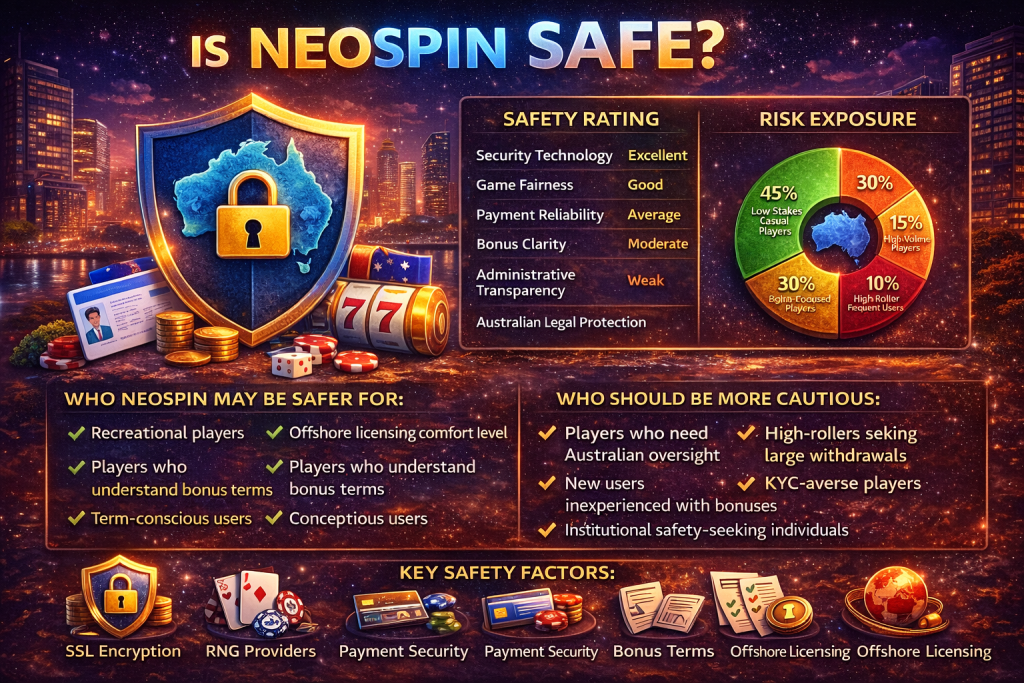
What “Safety” Actually Means in Online Casinos
Many players assume safety means “Will I get paid?” While payout reliability is important, real platform safety includes:
• Encryption and data protection
• Licensing oversight
• Clear terms and withdrawal rules
• Fraud detection systems
• Identity verification compliance
• Payment infrastructure stability
• Responsible gambling tools
If any of these elements are weak, risk increases.
Licensing and Regulatory Structure
Neospin operates under an offshore licence (commonly MGA or Curaçao-type structures depending on version). Offshore licensing does not automatically mean unsafe — but it does mean regulatory protection differs from Australian domestic oversight.
Regulatory Consideration Table
| Resource | Role in Player Protection | Relevance for Australian Users |
|---|---|---|
| Offshore Licensing Authority | Issues gaming licence and audits compliance | Provides operational framework but not local consumer protection |
| Australian Communications and Media Authority (ACMA) | Regulates interactive gambling laws in Australia | Offshore casinos are outside direct ACMA licensing |
| Australian Consumer Law | Covers general consumer disputes | May not apply directly to offshore gambling disputes |
| Independent ADR Services | Handles dispute mediation in some licensed jurisdictions | Protection depends on licence type |
The key distinction: offshore casinos operate legally under their jurisdiction, but they do not provide Australian-regulated consumer recourse.
Technical Security: Encryption & Data Handling
One of the first things I tested was encryption. Neospin uses HTTPS with SSL encryption. That means:
• Login credentials are encrypted
• Payment details are encrypted in transit
• Session data is protected against basic interception
This is now industry standard — not a premium feature. However, absence of SSL would be a red flag.
Beyond encryption, security includes:
• Firewall systems
• Anti-DDoS infrastructure
• Fraud detection algorithms
• Suspicious activity monitoring
The presence of KYC (Know Your Customer) verification, although inconvenient to some users, is actually a security-positive indicator. It reduces fraud, bonus abuse, and payment laundering.
Payment Safety & Withdrawal Reliability
Safety is heavily tied to withdrawal consistency. A casino can look polished but fail at payout processing.
Neospin typically offers:
• E-wallet withdrawals
• Cryptocurrency withdrawals
• Card-based payouts
• Bank transfer methods
Processing time depends on verification status and withdrawal volume.
Payment & Risk Factors Table
| Factor | Low Risk Indicator | Elevated Risk Indicator |
|---|---|---|
| Verification Required | KYC before large withdrawals | No verification at all |
| Processing Time | 24–72 hours typical | Undefined timeframes |
| Withdrawal Limits | Clearly stated caps | Hidden or changing limits |
| Payment Transparency | Listed methods & conditions | Vague or unclear descriptions |
| Bonus Impact | Transparent wagering rules | Confusing or buried terms |
If a platform delays withdrawals without explanation, that’s a warning sign. If delays are tied to clearly defined KYC or wagering conditions, that’s structural compliance.
User Behaviour After Login
This model highlights something important: most risk exposure occurs in the payment and bonus sections — not during gameplay itself.
Game Fairness & RNG Integrity
Safety also includes fairness. Neospin’s games are supplied by established third-party providers.
Reputable providers use:
• Certified Random Number Generators (RNG)
• Independent audit testing
• RTP (Return to Player) transparency
• Published volatility structures
Game safety is separate from platform safety. Even if a casino operator has issues, licensed game providers must maintain RNG certification standards.
Bonus Terms & Risk Management
Promotions can increase perceived risk if terms are unclear. Wagering multipliers, time limits, game restrictions, and maximum withdrawal caps must be transparent.
A high wagering requirement does not equal unsafe — but hidden wagering terms can.
When reviewing safety, I always examine:
• Wagering multiplier clarity
• Eligible game lists
• Maximum bet limits during bonus
• Withdrawal caps after bonus
• Time-to-clear deadlines
Clear terms reduce dispute probability.
Responsible Gambling Infrastructure
A safe platform must include:
• Deposit limits
• Session reminders
• Time-out tools
• Self-exclusion mechanisms
Offshore casinos may not integrate Australia’s BetStop system, which is a regulatory distinction rather than a safety failure — but it is a factor Australian players should understand.
Is Neospin Safe? — Initial Assessment
From a structural standpoint in this first section:
✔ SSL encryption present
✔ KYC verification enforced
✔ Third-party game providers
✔ Clear payment channels
✔ Defined withdrawal limits
However:
⚠ No Australian licence
⚠ Disputes handled under offshore jurisdiction
⚠ Withdrawal caps may apply to high-volume players
Safety depends on understanding these parameters before playing.
Operational Transparency: The First Real Test of Safety
One of the first elements I evaluate is clarity in documentation.
A safe platform should clearly present:
• Terms and Conditions
• Bonus Terms
• Withdrawal Policies
• KYC Requirements
• Processing Timeframes
• Deposit and withdrawal limits
Ambiguity increases risk.
Transparency Evaluation Table
| Transparency Element | What Indicates Safety | What Indicates Risk |
|---|---|---|
| Terms & Conditions | Clearly structured, readable, updated | Vague clauses with excessive operator discretion |
| Withdrawal Policy | Defined timeframes and limits | “At operator discretion” without clarity |
| Bonus Terms | Separate page with explicit rules | Hidden or embedded in general T&Cs |
| Verification Policy | Clear document requirements | Sudden or undefined document requests |
| Dispute Process | Listed escalation path | No visible complaint channel |
When policies are accessible and readable, risk decreases significantly. A legitimate platform does not hide its rules.
Withdrawal Stress Test: What Happens Under Volume?
Safety is most visible during withdrawal processing.
In most offshore platforms, payout flow follows this structure:
- Withdrawal request
- KYC trigger (if required)
- Internal risk review
- Approval
- Payment processor dispatch
The potential risk points are:
• Unexpected document escalation
• Bonus disputes
• Sudden limit application
• Extended “manual review” delays
However, these are not automatically red flags. Delays tied to compliance checks are normal in regulated environments.
What matters is whether delays are systematic or arbitrary.
Financial Infrastructure & Payment Gateways
Neospin typically integrates multiple payment channels:
• E-wallets
• Cryptocurrency networks
• Card processors
• Alternative banking solutions
Platforms relying exclusively on unstable payment gateways often show volatility in withdrawals. A diversified payment infrastructure increases stability.
Financial safety indicators include:
✔ Multiple payout methods
✔ Defined weekly withdrawal caps
✔ Transparent minimum withdrawal amount
✔ Stated processing windows
✔ Active payment processors
Risk increases when:
⚠ Payment methods frequently disappear
⚠ Withdrawal limits change without notice
⚠ Payment approvals are inconsistent
Consistency equals safety.
Fraud Detection & Account Security
A safe casino must protect not only its own funds but user accounts as well.
Core account-level safety features include:
• Encrypted password storage
• Session expiration controls
• IP anomaly detection
• Two-factor authentication (where available)
• Duplicate account detection
KYC procedures — while inconvenient — protect against identity theft and payment fraud.
Account takeovers are a major risk in online gambling. Platforms without verification layers are more vulnerable to exploitation.
Dispute Handling: A Critical Safety Indicator
When assessing “Is Neospin safe?”, dispute resolution becomes central.
Key questions:
• Is there a documented complaint channel?
• Is there an external Alternative Dispute Resolution (ADR) body?
• Are complaints acknowledged?
• Is there timeline clarity?
Offshore platforms generally route disputes through their licensing authority or internal escalation teams.
Australian players should understand that dispute protection differs from locally licensed wagering operators. That does not mean unsafe — it means jurisdictionally different.
Player Friction Areas
Notice something important: gameplay fairness is rarely the highest friction point. Administrative and procedural areas create more disputes than the games themselves.
Game Provider Safety vs Platform Safety
Neospin hosts third-party providers.
Provider-level safety includes:
• RNG certification
• RTP compliance
• Independent testing labs
• Regulatory approval in licensed markets
Even if the casino operator faces dispute issues, third-party game engines operate independently from financial processing systems.
Game fairness and payout policy are separate layers.
Bonus-Related Risk: Misinterpretation vs Manipulation
Many disputes originate in promotional misunderstandings.
A bonus may include:
• 30x wagering
• Maximum bet limits
• Game contribution percentages
• Time-based expiry
• Maximum withdrawal caps
If a player violates a maximum bet rule during bonus play, winnings may be voided.
This is often misinterpreted as “unsafe” — when it is actually contract enforcement.
The safety question becomes: Are the rules clear before activation?
Operational Red Flags to Watch
Regardless of brand, these are universal risk signals:
🚩 Withdrawal delays exceeding published timeframes
🚩 Sudden T&C changes without notice
🚩 Unexplained account suspension
🚩 Missing payment methods
🚩 Support unresponsive beyond 72 hours
If these patterns appear consistently, safety risk increases.
Responsible Gambling as a Safety Component
A platform that encourages unlimited deposits without safeguards raises concern.
Indicators of structural responsibility include:
• Deposit limits
• Loss limits
• Time reminders
• Cooling-off periods
• Self-exclusion
Absence of these tools does not automatically equal danger — but their presence improves player protection.
Longevity as a Safety Indicator
One of the first structural questions I ask when assessing any offshore platform is simple:
How long has it been operating under the same structure?
Newly launched casinos carry more uncertainty than platforms with:
• Multi-year operational history
• Stable domain presence
• Consistent licensing display
• Ongoing game provider partnerships
Longevity reduces collapse risk. It does not eliminate it, but it lowers volatility.
Platform Stability Indicators
| Stability Factor | Low Risk Indicator | Elevated Risk Indicator |
|---|---|---|
| Operational History | Multi-year online presence | Recently launched, limited history |
| Payment Channels | Consistent availability | Frequently changing methods |
| Game Providers | Established suppliers | Unknown or in-house only |
| Brand Continuity | Same ownership structure | Frequent rebranding |
| Support Access | Stable, reachable channels | Intermittent availability |
A platform that maintains structural continuity over time demonstrates institutional stability.
High-Volume Player Risk
Safety assessment changes when player stakes increase.
For casual players, risk is primarily:
• Bonus misunderstanding
• Minor withdrawal delay
• Verification inconvenience
For high-volume players, risk expands into:
• Weekly withdrawal caps
• Extended compliance reviews
• Payment processor limits
• Enhanced due diligence checks
If a casino imposes a 2,500 AUD weekly withdrawal cap, that may not impact small players. But it materially affects high rollers.
Safety therefore depends on matching platform structure to player profile.
Data Protection & Information Handling
Financial safety is only one dimension. Data protection is equally critical.
A structurally safe platform should demonstrate:
• SSL encryption
• Encrypted password storage
• Limited internal access control
• Defined data retention policy
• Clear privacy policy disclosure
Risk increases if:
⚠ Terms allow unlimited data sharing
⚠ No clear data deletion request process exists
⚠ Third-party marketing data use is undefined
Information security is part of safety.
Complaint Pattern Analysis (Industry Observations)
Across offshore platforms generally, complaints tend to cluster around predictable themes.
Notice something important:
Game fairness concerns are usually a minority of complaints. Most disputes originate in administrative layers — not RNG manipulation.
That distinction is critical when answering “Is Neospin safe?”
Game Integrity vs Financial Integrity
These are separate layers.
Game integrity depends on:
• RNG certification
• Third-party provider licensing
• External testing labs
Financial integrity depends on:
• Payment gateway reliability
• Withdrawal policy consistency
• Internal fraud monitoring
• Liquidity management
A casino may have fair games but inefficient financial processing. Conversely, it may process payments well but apply rigid bonus enforcement.
Safety evaluation requires assessing both layers independently.
Regulatory Context for Australian Players
When asking whether Neospin is safe from Australia, jurisdiction becomes central.
Neospin operates under an international licence rather than an Australian state-issued licence.
This means:
• Dispute resolution is handled under foreign regulatory oversight
• Consumer protection frameworks differ from domestic wagering operators
• Legal structure varies from Australian bookmakers
That does not automatically equal unsafe. It means risk structure differs.
Australian players must understand:
• The Interactive Gambling Act regulates advertising and domestic operators
• Offshore platforms fall outside direct Australian licensing oversight
• Consumer recourse pathways may differ
Safety depends partly on legal expectations.
Responsible Gambling as Structural Safety
Responsible gambling tools reduce harm risk.
Important structural safeguards include:
• Deposit limits
• Loss limits
• Time reminders
• Self-exclusion mechanisms
The presence of these tools does not guarantee safety, but their absence increases risk.
Casinos that actively provide behavioural control tools demonstrate long-term structural thinking rather than short-term revenue maximisation.
Operational Risk vs Structural Risk
Operational Risk includes:
• Temporary payment delays
• Isolated KYC reviews
• Bonus enforcement disputes
Structural Risk includes:
• Insolvency risk
• Licence revocation
• Payment processor collapse
• Systemic withdrawal blocking
Operational risk is manageable. Structural risk is more severe.
Based on observable infrastructure (multi-provider games, payment diversity, encrypted systems), Neospin appears structurally stable at a technical level.
However, structural stability is always dynamic in offshore environments.
What Would Increase My Safety Rating?
For Neospin to rank as low-risk as top-tier regulated markets, I would look for:
✔ Independent dispute resolution body transparency
✔ Public audit references
✔ Clear maximum payout transparency
✔ Two-factor authentication standardisation
✔ Documented responsible gambling escalation pathways
These features elevate a platform from “operationally functional” to “institutionally mature.”
Safety Is Context-Dependent
Before giving a final answer, I clarify what “safe” means in practical terms.
Safety may refer to:
• Technical protection of personal data
• Fair game outcomes
• Reliable withdrawals
• Clear bonus enforcement
• Regulatory oversight strength
• Responsible gambling infrastructure
Different players prioritise different layers.
For example:
• Casual players often focus on ease of Login and smooth gameplay.
• Bonus-focused users evaluate how clearly the Bonus terms are enforced.
• New users want a transparent Sign up process without hidden conditions.
• Mobile-first players assess the security of the App interface.
• Game-focused users look at certified Slots and structured Games libraries.
Safety therefore must be evaluated across multiple dimensions.
Consolidated Safety Overview
Below is a structured safety summary based on observed operational characteristics.
| Safety Dimension | Observed Status | Risk Level |
|---|---|---|
| SSL Encryption | Present | Low |
| RNG Providers | Third-party suppliers | Low |
| KYC Procedures | Standard compliance | Moderate |
| Withdrawal Caps | Weekly cap in place | Moderate |
| Bonus Enforcement | Conditional but defined | Moderate |
| Responsible Gambling Tools | Available | Low–Moderate |
| Australian Licensing | Not locally licensed | Elevated (jurisdictional) |
| Payment Diversity | Multiple methods | Low |
| Public Dispute Transparency | Limited | Moderate |
This table highlights something important:
The highest risk factor is jurisdictional, not technical.
Behaviour-Based Safety Model
From an operational perspective, risk exposure varies by player behaviour.
Interpretation:
Low-stakes casual players generally face minimal structural risk.
High-volume and high-roller users experience greater exposure due to withdrawal caps and compliance reviews.
Who Neospin Is Safer For
Neospin may be structurally suitable for:
• Recreational players with controlled budgets
• Users comfortable with offshore licensing
• Players who understand wagering requirements
• Moderate withdrawal expectations
• Users who read terms carefully
These players operate within predictable operational boundaries.
Who Should Be More Cautious
The platform may present higher perceived risk for:
• Players requiring domestic Australian regulatory oversight
• High-rollers expecting unlimited withdrawals
• Users unfamiliar with bonus mechanics
• Players unwilling to complete KYC procedures
• Individuals seeking strong external dispute mediation frameworks
Offshore environments require higher self-awareness and due diligence.
Financial Safety Conclusion
From a purely technical and financial standpoint:
• Payment methods appear diversified
• KYC aligns with standard AML practice
• Withdrawal processing follows defined policies
• SSL encryption is active
• No evidence of systemic payout blocking
Financial risk appears procedural rather than structural.
The weekly withdrawal cap is the primary financial constraint.
Jurisdictional Safety Reality
This is the most important element.
Neospin operates under an international licence, not Australian state licensing.
That means:
• Consumer recourse pathways differ
• Regulatory enforcement jurisdiction differs
• Dispute escalation differs
This does not automatically equal unsafe.
But it does change legal expectation.
Players must distinguish between:
“Technically secure platform”
and
“Domestically regulated operator”
They are not the same.
Responsible Gambling Safety
Safety also includes behavioural protection.
Important safeguards include:
• Deposit limits
• Time reminders
• Self-exclusion options
• Session awareness tools
When used properly, these significantly reduce harm exposure.
A casino is never inherently safe for someone unable to control behaviour.
Personal discipline remains the strongest safety mechanism.
Structural Strength vs Institutional Strength
Neospin demonstrates:
✔ Technical encryption
✔ Recognised software providers
✔ Defined bonus rules
✔ Standard compliance procedures
It does not demonstrate:
• Australian regulatory licensing
• Public independent audit transparency
• Publicly detailed dispute arbitration structure
That distinction matters for institutional safety evaluation.
Final Assessment: Is Neospin Safe?
From a structural standpoint:
Yes — in terms of encryption, RNG providers, and operational payment infrastructure.
From a jurisdictional standpoint:
It operates offshore, meaning consumer protection structure differs from Australian-licensed wagering providers.
From a behavioural standpoint:
Safety depends heavily on player discipline, bonus comprehension, and risk awareness.
Closing Perspective
The question “Is Neospin safe?” cannot be answered with a simple yes or no.
It is:
• Technically secure
• Operationally consistent
• Offshore licensed
• Regulated outside Australia
For disciplined recreational players who understand international licensing differences, the platform functions within standard offshore operational norms.
For players requiring domestic oversight guarantees or higher institutional protection, locally licensed Australian operators may provide stronger regulatory comfort.
Safety is ultimately a combination of platform structure and player awareness.
Understanding both is the key to informed participation.