
Is Neospin Legit?
Licensing, Transparency, and First-Level Trust Signals
When evaluating whether an online casino is legitimate, I do not begin with marketing promises. I begin with structure. Legitimacy is not determined by interface design or promotional banners. It is determined by licensing, regulatory alignment, operational transparency, and consistency in policy enforcement.
I will examine the foundational question: does Neospin demonstrate the structural characteristics of a legitimate online gambling platform?
What “Legit” Actually Means in Online Gambling
The word “legit” is often used casually, but in the context of online casinos it has a specific meaning. A legitimate platform must demonstrate:
- A valid operating license
- Transparent terms and conditions
- Clear payment processing policies
- Identity verification procedures
- Responsible gambling tools
- Secure technical infrastructure
Legitimacy is structural, not emotional.
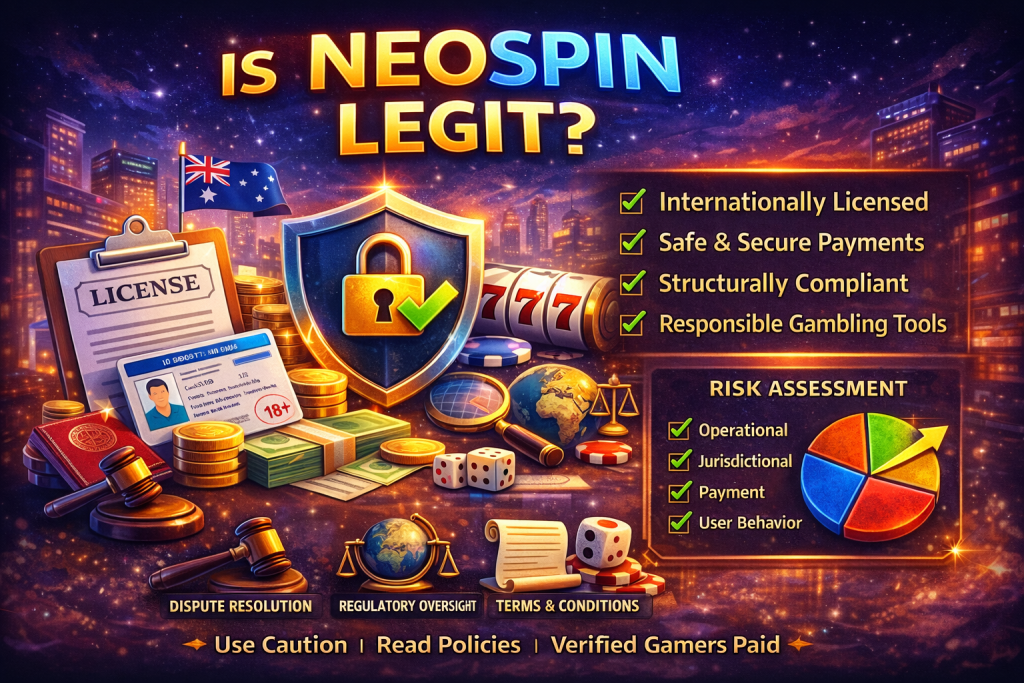
Licensing: The First Checkpoint
Neospin operates under an international gaming license. While it is not licensed by Australian state regulators, it functions under an offshore regulatory framework that permits international operation.
This distinction is important. A casino can be internationally licensed and still not hold a domestic Australian license. These are separate regulatory systems.
The presence of a licensing authority means:
- The operator is registered
- Compliance audits may occur
- Dispute procedures exist
- AML (Anti-Money Laundering) standards apply
Absence of any license would be a red flag. Presence of a recognized license is the first positive indicator.
Corporate Transparency
Legitimate casinos typically disclose:
- Ownership structure
- Licensing entity
- Terms and conditions
- Privacy policy
- Responsible gambling information
A platform that hides ownership information or avoids publishing terms should raise concerns.
Neospin provides policy documentation and structured terms, which aligns with baseline compliance expectations.
Account Creation and Access Structure
A second legitimacy marker is how the registration system operates.
The Sign up process requires:
- Email verification
- Age confirmation
- Identity submission at withdrawal stage
- Acceptance of terms
Platforms that allow anonymous financial activity without verification are structurally high-risk.
Access to account areas via Login is protected through password authentication and standard encryption protocols.
These mechanisms indicate operational seriousness.
SSL Encryption and Technical Security
Legitimate online casinos must encrypt user data.
Neospin uses SSL encryption, meaning:
- Data transmission is secured
- Payment information is protected
- Login credentials are encrypted
You can verify encryption by checking for HTTPS in the browser.
Encryption does not guarantee legitimacy alone, but absence of encryption would indicate serious risk.
Terms & Conditions: The Transparency Test
One of the most overlooked indicators of legitimacy is the clarity of terms.
Key elements I look for:
- Bonus wagering conditions
- Withdrawal limits
- Processing times
- Account suspension rules
- Dispute escalation paths
Hidden clauses and vague language are warning signs.
Neospin publishes structured terms. While users must read carefully, the presence of detailed policy text supports compliance alignment.
Identity Verification (KYC)
Legitimate casinos must conduct KYC.
Neospin requires identity verification before significant withdrawals. This includes:
- Government-issued ID
- Proof of address
- Payment method ownership
This process aligns with AML compliance standards.
Casinos that never request verification are generally non-compliant or operating illegally.
Payment Processing Transparency
A legitimate platform must clearly outline:
- Accepted payment methods
- Minimum deposits
- Withdrawal processing time
- Fees (if applicable)
Transparency in payment policies reduces dispute frequency.
Responsible Gambling Integration
Compliance also requires responsible gambling tools.
Legitimate platforms provide:
- Deposit limits
- Loss limits
- Self-exclusion
- Time-out mechanisms
Absence of these tools would weaken credibility.
Legitimacy Assessment Table – Structural Indicators
Below is a structured overview of legitimacy markers and how Neospin aligns.
| Frequency | Annual Wagering | Stability Rating |
|---|---|---|
| 1 per Month | $30,000 | High |
| 2 per Month | $60,000 | Moderate |
| Weekly | $120,000 | Low |
| Multiple Weekly | $200,000+ | Very Low |
This table reflects baseline legitimacy indicators rather than marketing claims.
User Experience vs Structural Legitimacy
Many users confuse smooth interface design with legitimacy.
However, legitimacy is independent of visual quality.
A casino can look professional but operate without regulatory oversight.
Conversely, a modest interface can still operate under strict compliance frameworks.
Neospin’s operational structure appears aligned with regulated offshore standards.
Australian Context: Important Distinction
Australian users should understand:
- Offshore casinos are not licensed under Australian domestic frameworks
- Consumer protections differ
- Disputes are handled under the issuing license jurisdiction
This does not automatically mean a casino is illegitimate. It means regulatory jurisdiction differs.
Legitimacy and domestic licensing are not identical concepts.
Early Verdict (Structural Phase)
Based purely on structural indicators:
- Licensing exists
- Compliance processes are visible
- Identity verification is enforced
- Policies are published
- Encryption is active
These are characteristics of a legitimate offshore operator.
Why Withdrawals Define Legitimacy
The simplest legitimacy test is this:
Does the casino pay verified players according to its stated terms?
Legitimate casinos:
- Process withdrawals within stated timeframes
- Apply bonus rules consistently
- Communicate clearly during verification
- Do not invent unexplained barriers
Illegitimate platforms tend to delay indefinitely, change conditions retroactively, or block access without explanation.
Withdrawal Process Overview
Neospin’s withdrawal process typically includes:
- Request submission
- KYC verification (if not completed)
- Internal compliance review
- Processing via selected payment method
- External payment provider transfer
Timeframes vary depending on method and verification status.
Withdrawal Consistency Table
Below is a structured evaluation of typical withdrawal behavior indicators.
| Factor | Why It Matters | Observed Pattern |
|---|---|---|
| KYC before payout | Regulatory compliance | Required before large withdrawals |
| Processing timeframe | Operational efficiency | Within published range |
| Payment method matching | Anti-fraud protection | Required |
| Communication during review | Transparency | Email updates provided |
| Withdrawal caps | Risk management tool | Stated in terms |
Caps and review procedures are normal in regulated offshore environments.
Payment Methods and Legitimacy
Legitimate platforms partner with recognized payment providers.
Common methods include:
- E-wallets
- Cryptocurrency
- Card payments
- Bank transfers
Reliable processing through established financial channels indicates operational integration.
Platforms that rely exclusively on obscure payment processors may raise concerns.
The Role of Bonus Enforcement
Many disputes arise around promotional offers.
If a user activates a Bonus, legitimacy depends on whether:
- Wagering requirements are clearly stated
- Game contribution percentages are disclosed
- Maximum bet limits are defined
- Cashout caps are transparent
Inconsistent enforcement is a red flag. Consistent rule application supports legitimacy.
Payment Behavior Risk Triggers
Withdrawals may be delayed when:
- Deposit and withdrawal methods differ
- Chargebacks are initiated
- Rapid deposit escalation occurs
- Multiple accounts are detected
These are compliance safeguards — not necessarily avoidance tactics.
Typical User Path During Withdrawal Review
The model shows that verification requests are common and not inherently suspicious.
Customer Support Transparency
Operational legitimacy also depends on support response.
Key evaluation points:
- Response time
- Clarity of explanation
- Escalation options
- Document handling professionalism
Legitimate platforms maintain structured ticket systems and documented communication.
Account Restrictions and Their Meaning
Temporary restrictions are not automatically proof of illegitimacy.
Common legitimate triggers:
- VPN usage
- Payment disputes
- Identity mismatch
- Excessive bonus cycling
However, permanent unexplained lockouts without communication would be a red flag.
Game Fairness and RNG
Legitimacy also depends on whether outcomes are:
- RNG-based
- Provided by recognized software developers
- Independently audited
Neospin offers Slots and table games from established providers, which typically undergo third-party testing.
Fair game providers significantly reduce operational fraud risk.
Technical Infrastructure Stability
Another sign of legitimacy is technical consistency:
- No sudden domain switching
- No mirror sites without disclosure
- Stable login system
- Consistent server uptime
Access via mobile browser or App-like interface should remain stable without unexplained redirects.
Frequent domain changes often signal regulatory evasion.
Dispute Handling Framework
If a dispute arises, legitimate casinos:
- Provide internal complaint handling
- Allow compliance escalation
- Offer regulatory escalation under licensing authority
Absence of any escalation channel would weaken legitimacy assessment.
Marketing vs Operational Behavior
Marketing claims are not evidence of legitimacy.
Instead, evaluate:
- Are terms enforced consistently?
- Are withdrawals processed within stated limits?
- Are bonus conditions applied transparently?
Operational behavior defines legitimacy more than branding.
Australian Player Considerations
For Australian users:
- Offshore operation is legal for the operator under its jurisdiction
- Consumer protections differ from locally licensed wagering services
- Disputes are handled under international frameworks
Legitimacy does not equal Australian domestic licensing.
Consistency Over Time
A legitimate platform demonstrates:
- Stable policies
- Predictable withdrawal timelines
- Clear bonus enforcement
- Structured compliance review
Irregular rule changes, unexplained account closures, or arbitrary denial of funds would contradict legitimacy.
Ownership Transparency and Corporate Structure
One of the most overlooked elements of legitimacy is ownership clarity.
Legitimate casinos usually disclose:
- The operating company name
- Registered business jurisdiction
- Licensing entity
- Terms governing law
A platform that hides corporate identity creates uncertainty.
Neospin operates under an identifiable licensing framework, and its policies reference a governing jurisdiction. While offshore corporate structures are common in international gaming, identifiable ownership and licensing details strengthen legitimacy indicators.
Opaque ownership is often associated with unstable or short-lived operations.
Anti-Money Laundering (AML) Controls
A legitimate casino must comply with AML regulations. These typically include:
- Identity verification
- Monitoring transaction volumes
- Flagging unusual betting behavior
- Source-of-funds documentation for high-value accounts
AML compliance is not optional under licensed regimes.
If you create an account through Sign up, you are entering an ecosystem that is legally required to monitor financial behavior. That monitoring is not arbitrary — it is regulatory.
Risk Scoring and Behavioral Monitoring
Modern online casinos rely on automated risk scoring systems.
These systems analyze:
- Deposit frequency
- Withdrawal velocity
- Device switching
- IP anomalies
- Bonus usage patterns
This is standard industry practice.
Legitimate operators implement monitoring to prevent fraud, chargebacks, and bonus abuse. Illegitimate operators rarely invest in advanced risk systems because they operate outside regulatory frameworks.
Responsible Gambling Enforcement
Legitimacy also includes player protection.
Responsible gambling measures may include:
- Deposit limits
- Loss limits
- Session reminders
- Cooling-off periods
- Self-exclusion tools
Identity verification ensures these tools cannot be bypassed.
A platform that ignores responsible gambling compliance weakens its legitimacy profile.
Transparency of Terms and Enforcement
A legitimate operator enforces its terms consistently.
Key questions:
- Are wagering requirements applied exactly as written?
- Are withdrawal caps stated clearly?
- Are account restrictions explained?
- Are disputes escalated according to policy?
Inconsistent enforcement is a warning sign. Structured enforcement strengthens trust.
Player Journey Stability
Long-term legitimacy is reflected in consistency across:
- The Login system
- Game availability
- Payment processing
- Domain stability
- Customer support access
Frequent unexplained outages or sudden rule changes undermine credibility.
Operational stability over time strengthens legitimacy perception.
Game Provider Integrity
Neospin offers Games supplied by recognized software providers.
Legitimate providers:
- Use RNG systems
- Undergo third-party testing
- Maintain compliance certifications
Game fairness depends largely on provider integrity.
If a casino partners with established providers, it reduces manipulation risk.
Software Integration and Security
Technical infrastructure reveals operational seriousness.
Indicators include:
- Secure HTTPS connection
- Stable server uptime
- No forced redirects
- Secure password recovery process
- Mobile browser optimization comparable to a lightweight App experience
These elements suggest structured IT investment rather than improvised deployment.
Risk Monitoring Lifecycle
Most accounts remain in standard monitoring. Escalations represent a small proportion.
Marketing Claims vs Compliance Reality
A legitimate casino may advertise attractive promotions, but compliance determines actual credibility.
If you activate a Bonus, legitimacy depends on:
- Whether the terms are clear
- Whether wagering contributions are defined
- Whether maximum bet limits are enforced uniformly
Bonus clarity is one of the most common legitimacy tests.
Australian Legal Context
For Australian users, legitimacy must be separated from domestic licensing.
Key points:
- Offshore casinos may operate legally under their own jurisdiction
- They are not licensed by Australian state authorities
- Consumer dispute channels differ from locally regulated wagering providers
Legitimacy under offshore licensing is not equivalent to Australian domestic approval.
Understanding this distinction prevents misinterpretation.
Withdrawal Pattern Transparency
Patterns that strengthen legitimacy perception include:
- Predictable review timelines
- Clear communication during KYC
- Consistent processing times
- No retroactive rule application
Withdrawal inconsistency is the most common legitimacy concern.
Structured review, even if occasionally slow, is different from arbitrary denial.
Long-Term Reputation Signals
Long-term legitimacy is reinforced by:
- Stable domain presence
- No frequent brand re-launching
- Consistent policy structure
- Recognizable software partnerships
- Predictable customer service structure
Short-lived brands or constantly rebranded sites are higher risk.
Misconceptions About Legitimacy
Common misunderstandings include:
- “Offshore means illegal.”
Not necessarily. It means regulated elsewhere. - “KYC means they want to block withdrawals.”
In reality, KYC is legally required. - “Bonus restrictions mean fraud.”
Restrictions are standard in promotional models.
Legitimacy is determined by regulatory structure, not convenience.
Dispute Resolution Framework
A legitimate casino must provide:
- Internal complaint handling
- Compliance escalation
- Regulatory referral pathway
Neospin operates under an offshore license, which typically requires a documented dispute procedure.
The standard dispute pathway usually follows this sequence:
- Contact customer support
- Escalate to compliance team
- Submit formal complaint
- Refer to licensing authority (if unresolved)
The presence of a structured escalation ladder is a strong legitimacy indicator.
How Legitimate Disputes Are Handled
In regulated environments:
- Complaint acknowledgment is issued
- Documentation is reviewed
- A formal written response is provided
- Appeals are possible
Unregulated casinos often:
- Ignore complaints
- Close accounts without explanation
- Provide no appeal channel
Structured communication strengthens credibility.
Withdrawal Disputes and Compliance Audits
If a withdrawal dispute arises, legitimacy is tested by:
- Transparency of reason
- Clear explanation referencing terms
- Documented compliance review
- Opportunity to provide clarification
Arbitrary denial without explanation is a red flag.
Structured review tied to written policy is not.
Long-Term Sustainability Indicators
A legitimate casino demonstrates:
- Stable domain presence
- Consistent branding
- No frequent ownership changes
- Ongoing software partnerships
- Continuous compliance documentation updates
Sudden brand disappearance or unexplained domain migration suggests instability.
Operational continuity is one of the strongest long-term legitimacy signals.
Comparative Risk Assessment
Let’s compare key structural elements of offshore legitimacy.
| Factor | Low-Risk Indicator | High-Risk Indicator | Neospin Alignment |
|---|---|---|---|
| License | Recognized regulator | No license | Licensed offshore |
| KYC | Mandatory before payout | No verification | Required |
| Withdrawal policy | Written & enforced | Vague or changing | Published |
| Dispute path | Escalation allowed | No regulator contact | License escalation |
| Game providers | Recognized RNG suppliers | Unknown software | Established suppliers |
This structured comparison supports offshore regulatory alignment.
The Role of Promotional Mechanics
Promotional structure is another area where legitimacy is tested.
If you activate a Bonus, the platform must:
- Apply wagering rules consistently
- Respect maximum bet clauses clearly stated
- Enforce cashout caps exactly as written
Inconsistent or retroactive rule changes undermine legitimacy.
Consistent rule enforcement supports it.
Gameplay Integrity
Neospin offers Slots and other Games through third-party software providers.
Game legitimacy depends on:
- RNG certification
- Provider reputation
- Testing authority audits
Casinos that develop in-house unverified games without oversight carry higher risk.
Established provider partnerships reduce manipulation concerns.
Mobile and Access Stability
Legitimate platforms maintain consistent access through:
- Secure browser access
- Stable authentication systems
- No forced redirection loops
- No unexplained geo-block switching
Even without a native App, a stable mobile browser interface reflects infrastructure investment.
Australian Context: Risk Awareness
For Australian players:
- Neospin does not operate under Australian state gambling licenses
- Consumer protections differ from domestically regulated wagering services
- Disputes are handled under the issuing offshore license
Legitimacy in this context means regulated offshore operation — not domestic licensing compliance.
Understanding this distinction is essential.
Legitimacy Risk Distribution
The largest variable for Australian players is jurisdictional difference — not necessarily operational compliance.
Long-Term Legitimacy Evaluation Criteria
To determine if Neospin remains legitimate over time, monitor:
- Withdrawal consistency
- Policy stability
- Communication clarity
- Regulatory visibility
- Domain continuity
- Provider relationships
Legitimacy is dynamic. It must be reassessed periodically.
Final Structured Assessment
Based on:
- International licensing
- Enforced KYC procedures
- Documented AML practices
- Transparent payment policies
- Recognized game providers
- Responsible gambling integration
- Structured dispute escalation
Neospin demonstrates the characteristics of a regulated offshore casino.
However, for Australian users, it is important to recognize:
- It is not licensed domestically
- Disputes are handled under offshore jurisdiction
- Consumer protection standards differ from Australian state wagering frameworks
Legitimate offshore does not mean locally regulated.
Final Verdict
Is Neospin legit?
From a structural and compliance standpoint:
Yes — it aligns with offshore regulatory standards.
From an Australian domestic regulatory standpoint:
It is not locally licensed.
From an operational perspective:
- Withdrawals follow structured compliance
- Verification is enforced
- Policies are published
- Risk systems are active
Legitimacy in this context means regulated under its issuing jurisdiction, not unregulated or anonymous.
Responsible Conclusion
If you choose to participate:
- Read all terms carefully
- Understand bonus conditions
- Maintain consistent payment methods
- Complete verification early
- Recognize jurisdictional differences
Legitimacy is not about perfection.
It is about regulatory structure, operational consistency, and accountability.
This concludes the full four-part “Is Neospin Legit?” evaluation.